
Chiang Mai, once dominated by Chinese visitors, has gradually changed as the foreign market diversifies, with more arrivals from South Korea and Japan, as well as a notable resurgence of long‑haul tourists.
According to the Tourism Authority of Thailand (TAT), the province set a new record in 2025 with 12 million visitors, including 4 million from overseas.
Among the top five markets, the US ranked fifth after China, South Korea, Malaysia and Taiwan.
The province wants to capitalise on its heritage sites while developing new tourism products to maintain a steady flow of visitors.
Aiming to become a Unesco World Heritage site, Chiang Mai is accelerating landscape enhancements at its historic sites ahead of an assessment in June, according to the Chiang Mai provincial government.
The province started the development and improvement of the areas surrounding the seven temples nominated for World Heritage status, as well as the five city gates, four corners and the city walls, to ensure readiness for the evaluation.
In terms of new products, the province is focusing on health and wellness as it already has natural assets such as hot springs.
Watcharayu Kuawong, director of TAT’s Chiang Mai office, said the city improvements for the Unesco evaluation are expected to benefit travellers who enjoy roaming the old quarter, particularly foreign visitors who tend to prefer walking rather than driving, unlike most locals.
He said many hotels in the province have reported growth in long‑haul tourists, especially from the US and the UK.
The Yi Peng festival in November last year generated 2.8-3 billion baht in revenue from 20,000 visitors, 98% of whom were foreigners.
To maintain momentum in long‑haul markets, next month the Chiang Mai municipality plans to participate for the first time in the ITB Berlin trade show.
The province also wants to showcase its tourism products by joining forces with the private sector to diversify its market in Europe, including with Maetaeng Elephant Park.
HOT SPRINGS PROTOTYPE
Banking on the booming foreign market and rising demand for health tourism products, the royally initiated “San Kamphaeng Hot Springs Chiang Mai” project was designated as a prototype for hot spring attractions in the province and nationwide.
The first phase was approved, enabling it to complete the design process, and started construction in some parts with a combined budget of 198 million baht for fiscal 2025-26.
The funds were distributed by the Tourism Department.
Chalermsak Makmookphol, general manager at San Kamphaeng Hot Springs Chiang Mai, said a major facelift is expected for the hot spring, transforming the 73-rai plot into a holistic wellness destination, slated for completion in 2030-2031.
He said the renovated hot spring will offer visitors rejuvenation and mental restoration by utilising hot mineral springs and onsen spas, amid the mountain scenery of San Kamphaeng.
Mr Chalermsak said the facelift should increase income to 100 million baht per year, up from 37-40 million, by building pool villas with the hot spring nearby, which could lead to demand for wellness packages combined with accommodation in the future.
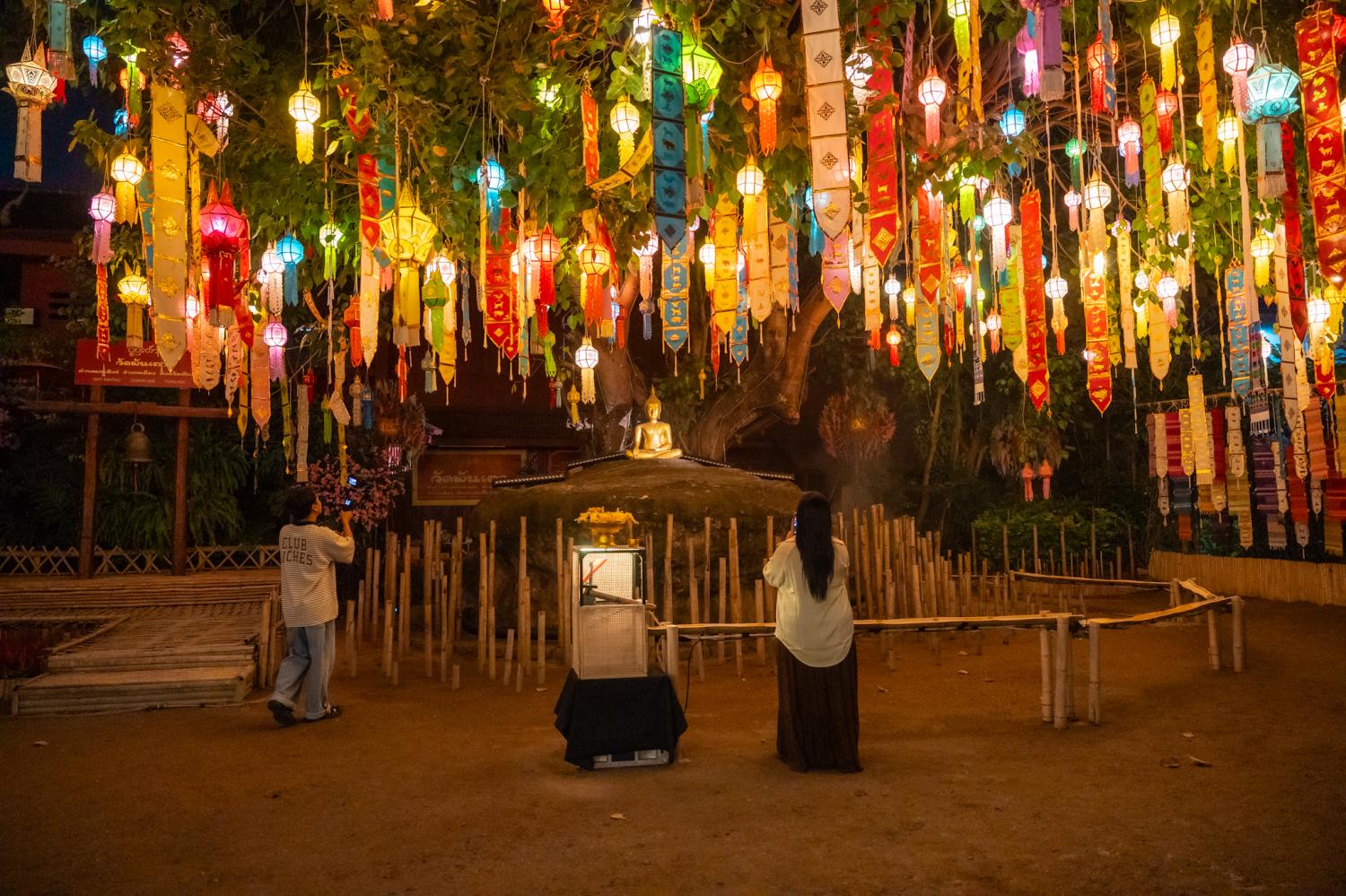 Tourists visit Wat Pan Tao in Chiang Mai during the city’s night market.
PUBLIC DISTRIBUTION
Since the hot springs was established in 1984, it has been mandated to distribute 45% of its profits to eight village cooperatives.
The facility has fixed operational costs of around 20 million baht per year, including 60 staff, all from the eight local villages.
Last year the springs attracted roughly 20% foreign tourists and 80% local guests.
However, after the renovation the share of international visitors is expected to increase to 40%, said Mr Chalermsak.
Similar to other attractions in the North, the hot springs benefits from cool weather during the high season, but typically experiences a sharp decline in visitors during the low season.
He said with more comprehensive services in the future, it could help secure other markets, such as long-stay guests enrolling in wellness programmes and meeting groups, as the project includes meeting spaces for both the government and private sectors.
MARKET ADAPTATION
In the past eight years, the San Kamphaeng Hot Springs earned cumulative profits of 48.8 million baht from 2.5 million total visitors.
Business was stunted by the pandemic in 2021, when it incurred losses of 2.43 million baht as visitor numbers dropped by 58%.
The balance sheet gradually recovered during 2022-2024 as it returned to profit, though the performance fell short of the profit record from 2018 of 12 million baht.
In 2025, the sharp decline in the Chinese market was evident at the hot springs, as Chinese visitors ranked fifth among foreigners, behind South Koreans, Japanese, British and Americans.
Mr Chalermsak said the hot springs are expected to regain momentum this year. Over the New Year holiday, the facility generated 4.3 million baht from 50,000 guests over a 10‑day period.
Bootha Chailert, president of Maetaeng Elephant Park, said the Chinese market has still not returned to normal.
Elephant parks across the province have yet to fully recover from the pandemic and the major flood that hit Chiang Mai two years ago, he said.
The number of elephants at Maetaeng declined to 70 from 100, though it remains the largest elephant park in the province.
The number of staff also dipped from 500 to 350.
“Many elephant parks nearby couldn’t survive the flood, prompting us to help them by buying 12 elephants for our park,” said Mr Bootha.
“We have to adapt to changing markets, focusing more on Indian and Southeast Asian visitors, along with those from the Middle East.”
Mr Chalermsak said the park still faces the challenge of explaining to Western markets how the traditional Asian approach to raising elephants in Chiang Mai differs from the management of wild elephants, which are far more numerous in Thailand’s Northeast.
Please credit and share this article with others using this link: https://www.bangkokpost.com/business/general/3193323/chiang-mai-tourism-in-flux. View our policies at http://goo.gl/9HgTd and http://goo.gl/ou6Ip. © Bangkok Post PCL. All rights reserved.
https://www.bangkokpost.com/business/general/3193323/chiang-mai-tourism-in-flux